



Billy, a UFC fan with 10+ years of experience, breaks down his UFC Fantasy lineup in the Stats Fight app.
UFC Predictions for UFC Fight Night 267: Build Your Winning Team in Stats Fight app
4 min read
Lineup Picks:
Billy also explains what he's tracking in Stats Fight app during the broadcast and why it's changing the fan experience.
1️⃣ Anthony Hernandez - 40 fantasy cost
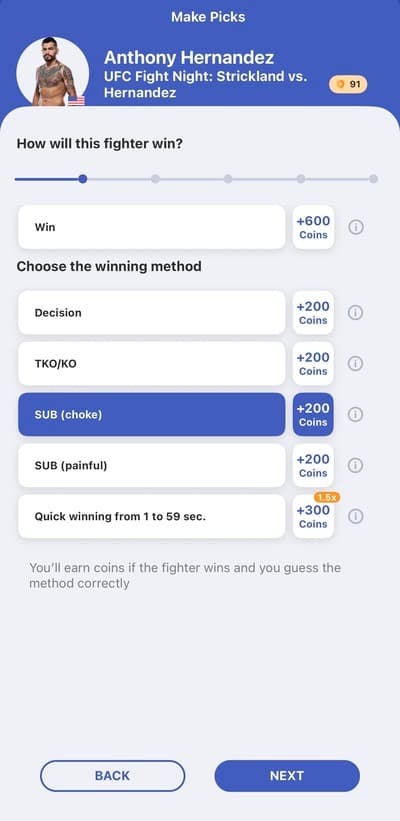
I’m starting with the main event: Anthony Hernandez for 40 fantasy cost. For anyone searching Anthony Hernandez next fight, this is the one that matters.
There’s a strong chance this fight goes long, which creates scoring upside through volume.
Hernandez holds a 91 Stats Fight Rating compared to 87 for Sean Strickland. That’s close — but meaningful.
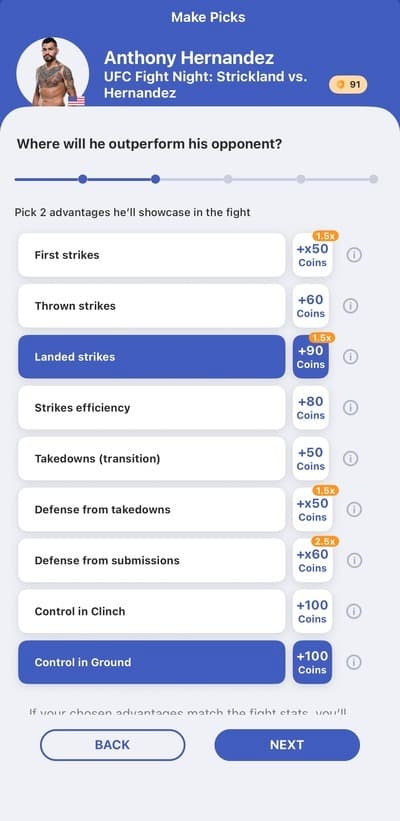
The real edge is grappling. Hernandez’s ground control sits near 89%. That’s massive in a five-round fight.
For method of victory, I’m choosing submission.
If he finishes, I get the method bonus.
If it goes the distance, I still score through control and activity.
Game plan elements I’m targeting:
- Ground control
- Landed strikes (5.23 per minute vs. 4.4 for Strickland)
My projected outcome: pressure, takedowns, positional dominance, and either a late submission or a strong decision win.
2️⃣ Geoff Neal - 40 fantasy cost
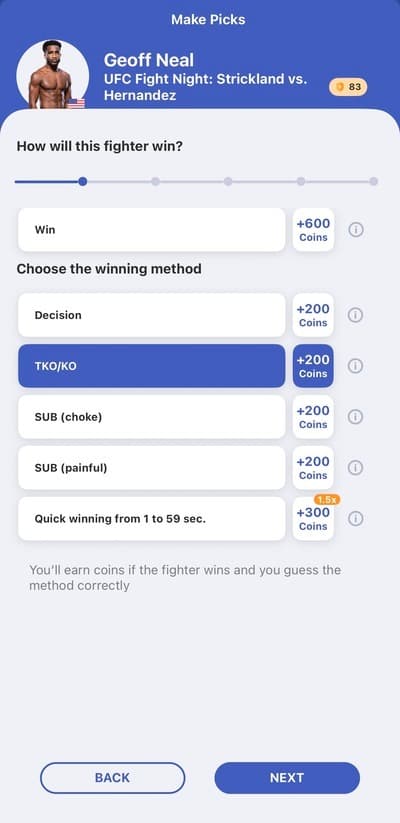
Next, Geoff Neal for 40 against Uros Medic.
Neal’s Stats Fight Rating: 83. Medic’s: 75.
This likely stays standing. Both are strikers.
Method of victory: KO/TKO.
Neal throws 11.51 strikes per minute vs. 7.42 for Medic.
He lands 4.92 per minute vs. 3.8.
That’s a big volume and accuracy edge.
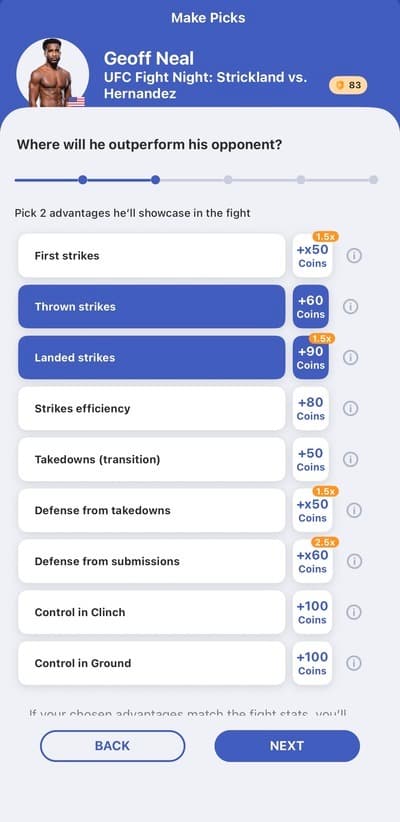
Game plan elements I’m targeting:
- Thrown strikes
- Landed strikes
If this turns into a high-paced striking fight, Neal could generate serious fantasy coins.
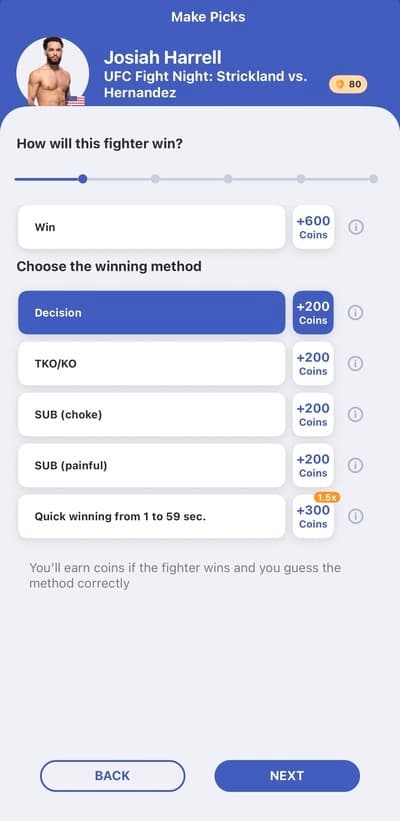
3️⃣ Josiah Harrell - 20 fantasy cost
With 20 fantasy cost left, this is where strategy matters most.
Josiah Harrell vs. Jacobe Smith.
Their Ratings are nearly identical: 80 vs. 81.
Both fighters are 11–0.
This is the kind of fight that separates sharp picks from casual selections.
I’m picking Harrell by decision.
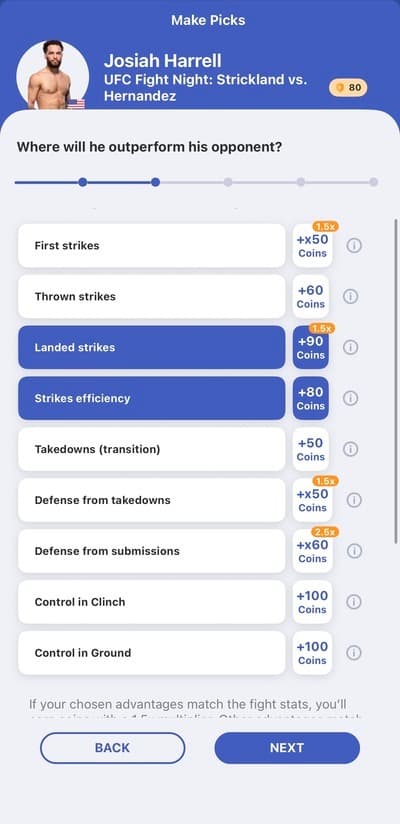
Game plan elements I’m targeting:
- Landed strikes - 8.84 per minute vs. 6.04
- Strike efficiency - 80% vs. 60%
If this goes all three rounds, I’m counting on volume and efficiency to carry him.
Once my lineup is locked, I switch into full experience mode.
I’ve got the broadcast on my TV — and on my second screen, I’m tracking UFC Live Stats inside the Stats Fight app.
Now I’m not just reacting to big moments.
I’m watching:
- Strike totals building in real time
- Control time ticking up
- Accuracy percentages shifting round by round
Every takedown matters.
Every exchange matters.
Every minute matters.
That’s the difference between just watching a fight and playing UFC Fantasy.
When I normally watch an event, I’m just a fan.
When I build picks inside a fantasy salary cap and follow Live Stats round by round, I’m thinking like a strategist.
I’m asking:
- Who wins minute by minute?
- Where is the scoring upside?
- Is this fight trending toward volume or control?
- Where is the smart upset?
This isn’t gambling.
It’s not random guessing.
It’s a competition built around understanding MMA.
If you truly know the sport, prove it.
You can play fantasy for free in the Stats Fight app on the App Store and Google Play.
Start right now.
FAQ
Frequently asked questions
What is UFC Fantasy in the Stats Fight app?
UFC Fantasy in Stats Fight is a skill-based competition where you build a lineup of fighters for a specific event, like UFC Fight Night 267: Strickland vs. Hernandez.
You don’t just pick winners — you predict how the fight unfolds. You choose:
- Winner
- Method of victory
- Key game plan elements (volume, control, efficiency, etc.)
Points are awarded based on real fight performance.
Is this gambling?
No.
There’s no need to risk real money. It’s a competition based on knowledge and analysis — not betting odds. You build a team within a fantasy salary cap and compete against other users based on performance scoring.
It’s about understanding MMA, not wagering.
How is this different from normal UFC Picks?
Typical UFC Picks are simple: pick the winner and maybe the method.
In Stats Fight:
- You must stay within a fantasy budget
- You can’t just stack all favorites
- You predict statistical performance
- You choose game plan elements
It’s strategic roster construction, not just guessing outcomes.
What are “game plan elements”?
Game plan elements are the technical areas you expect a fighter to dominate, such as:
- Ground control
- Strikes thrown
- Significant strikes landed
- Strike efficiency
Instead of only saying “Hernandez wins,” you’re predicting how he wins — through grappling dominance, volume striking, or finishing ability.
How do fantasy coins or salary cap work?
Each fighter has a fantasy cost.
You must build your lineup within the allowed budget. That means:
- Balancing favorites and underdogs
- Finding value plays
- Projecting performance upside
This is what makes lineup construction strategic.
Can I track fights live inside the app?
Yes.
During the event, you can follow UFC Live Stats in real time inside the Stats Fight app. On a second screen, you can track:
• Strike totals
• Control time
• Accuracy
• Round-by-round performance
This makes every minute of the fight matter.
Do I need to be an expert to play?
No — but knowledge helps.
Casual fans can play for fun.
Serious fans gain an edge through deeper analysis of pace, matchup styles, and statistical trends.
The more you understand MMA, the better your results.
Is it free to play?
Yes.
You can play fantasy MMA for free in the Stats Fight app on the App Store and Google Play.
How do I get started?
- Download the Stats Fight app
- Choose the upcoming UFC event
- Build your lineup within the fantasy budget
- Select winners, methods, and game plan elements
- Track your results live during the fights
Then compare your performance against other users.
Why does this change how I watch UFC?
Because now:
- Every exchange matters
- Every takedown impacts scoring
- Every round shifts your position
You stop watching passively — and start analyzing actively.
If you believe you truly understand MMA, this is where you prove it.